
Case study
Rangebank BESS: 220 kV GIS Testing and Substation Commissioning
Talk to an engineer: 1300 730 499 or service@megavar.com.au
- Client
- RJE Global
- Principal Contractor
- Fluence (BESS supplier and construction partner)
- Developer
- Eku Energy and Shell Energy Australia
- Asset Owner
- Eku Energy and Shell Energy Australia
- Location
- Cranbourne West, VIC
- Grid Connection
- 220 kV, Cranbourne Terminal Station
- Voltage
- 220 / 33 kV
- Asset Type
- 220 kV GIS and 220/33 kV BESS substation
- Project Type
- BESS substation HV testing, protection testing and commissioning
- Duration
- About four months on site (April to July 2024), following protection testing in February 2024
- Megavar Scope
- 220 kV GIS HV withstand and partial discharge testing; 220 kV VT testing; site acceptance testing of 220 kV line, transformer and 33 kV bus protection; GOOSE and primary injection testing; 33 kV switchboard contact resistance, circuit breaker timing and HV withstand testing

Overview
Rangebank is a 200 MW / 400 MWh battery energy storage system in Rangebank Business Park, Cranbourne West, in Melbourne's outer south east. Developed by Eku Energy and Shell Energy Australia, it connects at 220 kV through a feeder bay at the adjacent Cranbourne Terminal Station and was completed in December 2024. The site substation steps 220 kV down to 33 kV, where two switchboards collect the battery feeders.
Megavar was engaged by RJE Global, the balance of plant contractor, for HV testing and secondary commissioning of the substation. The work ran as separate packages: protection relay testing in February 2024, HV withstand and partial discharge testing of the 220 kV gas insulated switchgear in April 2024, and substation commissioning from late May to mid July 2024, with crews of up to seven testers on site in the peak weeks.
The scope covered the 220 kV GIS and its voltage transformers, duplicated X and Y protection on the 220 kV line, the 220/33 kV transformer and both 33 kV buses, and HV, contact resistance and circuit breaker timing tests on the 33 kV switchboards. It adds to Megavar's renewables and battery storage experience on substations across Australia.
Scope of Work
- Site acceptance testing of the 220 kV GIS to Megavar ITP MVITP-12564: insulation resistance, AC HV withstand with a 500 kV series resonant test set, and partial discharge measurement
- 220 kV voltage transformer withstand, ratio, polarity, phase shift and secondary winding resistance testing on all three phases
- Site acceptance testing of duplicated X and Y 220 kV line protection, including line differential pickups and circuit breaker fail
- Site acceptance testing of X and Y transformer protection on the 220/33 kV transformer, and of neutral earthing transformer monitoring relays
- Site acceptance testing of per phase X and Y bus protection on both 33 kV buses, with primary injection and bus stability checks
- IEC 61850 GOOSE testing of the 33 kV feeder protection on Bus 1 and Bus 2
- 33 kV switchboard contact resistance testing at 100 A and circuit breaker timing on the incomers, BESS feeders and auxiliary transformer feeders
- Power frequency HV withstand testing of both 33 kV switchboards at 56 kV for one minute, with insulation resistance before and after
- Capture of as-installed protection settings files at completion of testing
- Inspection and test plans and test reports issued to the client for each package
Equipment Commissioned
- 220 kV GIS: outdoor gas insulated switchgear with circuit breakers and disconnectors, tested as one circuit
- 220 kV voltage transformers: 3 x single phase inductive VTs, 220 kV primary with four secondary windings each
- 220 kV line protection: Siemens 7SL87 (X protection) and GE L90 (Y protection)
- Transformer protection: GE T60 (Set X) and SEL-487E (Set Y)
- 33 kV bus protection: GE Multilin B90 (X protection) and SEL-487B (Y protection), one relay per phase
- Neutral earthing transformer monitoring: Littelfuse SE-700 relays
- 33 kV switchboards: two boards with two incomers, 16 BESS feeders and two auxiliary transformer feeders
Megavar Test Equipment Deployed
- Phenix: 500 kV series resonant HV test set
- Omicron: CPC 100, CMC 356
- Megger: MIT515 5 kV insulation resistance tester, 10 kV MIT insulation resistance tester
- Megavar: 300 kV resonant HV test set
Test equipment like this is available for hire from Megavar: see our HV test equipment hire range.
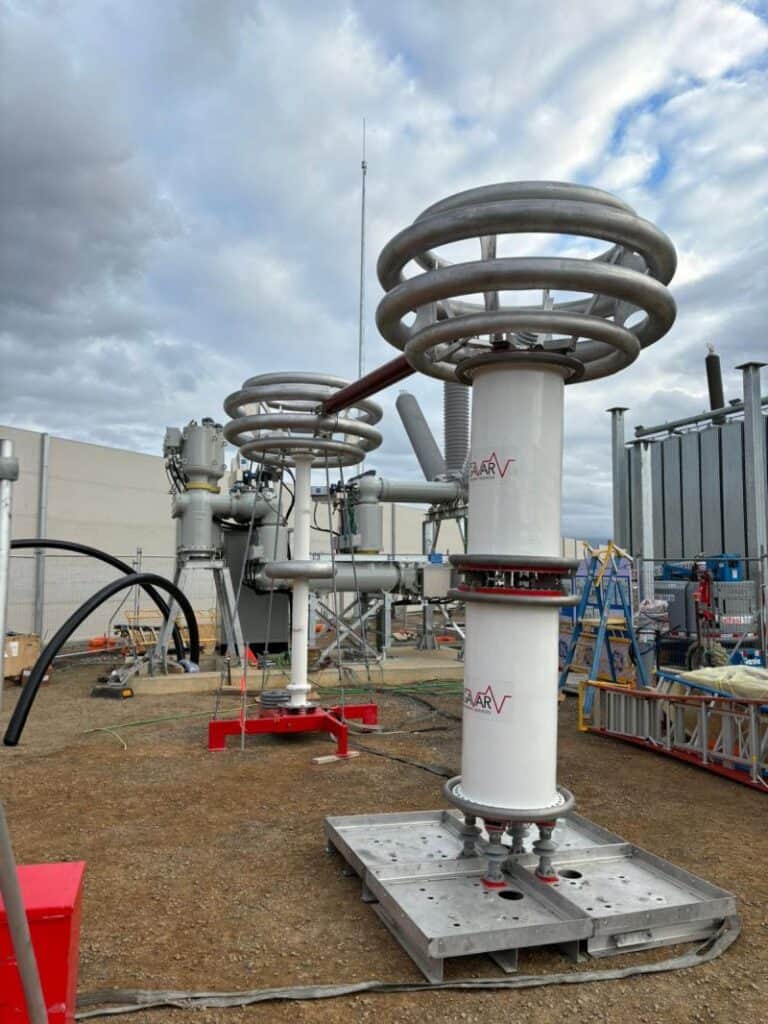
The 500 kV system: Megavar’s 500 kV series resonant set tunes to the capacitance of the test object, so it reaches GIS withstand voltages from a modest site supply, and resonance collapses at once if the insulation breaks down, which limits damage to the switchgear. It travels in a 20-foot shipping container Megavar fitted out for it, so it is loaded on and off as one unit and arrives at remote sites protected and ready to set up. The 300 kV and 500 kV resonant systems are supplied with Megavar’s test team; they are not available for dry hire.
Team: Testing and commissioning: a core team of 2 to 4 testers, increased to 7 in the peak commissioning weeks of June 2024, with project management support.
Standards: The 33 kV switchboards were tested to IEC 62271-1 clause 7.2.12 (voltage test as condition check at 80% of the rated short duration power frequency withstand voltage), and the 220 kV GIS to the manufacturer's site test voltages under Megavar's site acceptance test ITP.
Challenges and Approach
Flashover during the first 33 kV withstand
During the first HV withstand attempt on the 33 kV switchboard in June 2024, a flashover occurred at about 38 kV on the red phase cone bushing of one circuit breaker, where the cable boot would later terminate. Testing stopped immediately. After rubber insulation tubes over the exposed cones did not hold the voltage, Megavar, RJE Global and Fluence agreed to pause HV testing until the switchboard manufacturer provided a test procedure, rather than risk further damage to new plant.
Completing the switchboard test with the right accessories
With test boots fitted to the exposed cones, both 33 kV switchboards were retested over the weekend of 13 to 14 July 2024 at 56 kV for one minute, with insulation resistance measured before and after. One bushing boot cap failed on the blue phase of Switchboard 1 during the test; it was replaced and the board retested successfully, so both boards were proven before energisation.
Voltage transformers on the GIS
The 220 kV VTs could not be driven to the 127 kV conditioning voltage because of their inductive nature. They were withstand tested at 101 kV for one minute, a value verified and approved by the GIS manufacturer's representative on site, and then ratio, polarity, phase shift and secondary winding resistance tests were completed on every winding.
Wiring errors found during protection testing
Site acceptance testing of the transformer X protection found current inputs wired to the 5 A rather than the 1 A terminals, neutral CT currents drawn to the wrong inputs, crossed neutral CT wiring that failed restricted earth fault testing, and a circuit breaker status input on the wrong contact. Each fault was corrected, drawings were marked up, and the affected functions were retested before the relay was signed off.
Holding a compressed commissioning window
Commissioning ran from late May to mid July 2024 across four protection platforms from three manufacturers. To hold the programme, the crew was increased to seven testers in the peak weeks, after hours work was added in the week of 8 July at the client's request, and the 33 kV HV testing was completed over a weekend.
Outcomes
The 220 kV GIS, its voltage transformers, the duplicated line, transformer and bus protection, and both 33 kV switchboards were tested and documented ahead of energisation, with every defect found during testing corrected and retested. The battery was completed and fully operational in December 2024.
- 220 kV GIS passed AC withstand at 304 kV for 3 minutes and 380 kV for 1 minute, with partial discharge measured at 62.59 pC at 170 kV
- 3 x 220 kV voltage transformers withstand, ratio, polarity and winding resistance tested
- Duplicated X and Y protection site acceptance tested on the 220 kV line, the 220/33 kV transformer and both 33 kV buses
- 2 x 33 kV switchboards passed 56 kV power frequency withstand, with insulation resistance above 149 GΩ on every phase
- Transformer protection wiring defects found, corrected and retested before sign off
- More than 1,650 hours of testing and commissioning delivered across the GIS and substation packages
Reviewed by Megavar engineering team. Last reviewed October 2026. ISO 9001, ISO 14001, ISO 45001 certified. Electrical contractors licences held in every Australian state.
Need High Voltage Testing or Equipment?
Tell us what you need and when, and we will come back with availability and pricing.
Get In TouchFAQ
Frequently Asked Questions
What testing does a 220 kV GIS need before energisation?
Why is a resonant test set used for GIS withstand testing?
What happens if switchgear flashes over during an HV withstand test?
What protection is commissioned on a BESS substation?
How long did Megavar's work at Rangebank take?
Does Megavar test and commission BESS substations across Australia?
Request a quote
Tell us about the job
An engineer replies by the end of the next business day (Monday to Friday, 8:30 am to 5:00 pm). Scope still forming? Send what you have. Hiring equipment? Use the equipment hire pages or email rentals@megavar.com.au.
Talk to us now
1300 730 499service@megavar.com.auHire: rentals@megavar.com.auMonday to Friday, 8:30 am to 5:00 pmTrusted by top enterprises for exceptional results


