
Equipment hire
Thermal Imaging Camera for Hire
Day rates, 1 to 7 days, ex GST:
Every rate band is on the instrument page. Minimum hire one day.
Rates per day, ex GST
Thermal Imaging Equipment Available for Hire
Each instrument is supplied with its manuals. If one plays up, call us and we will arrange a fix or a replacement. No computer is supplied: where an instrument needs software, install it on your own computer.
Flir
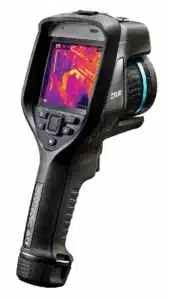
The FLIR E75 is a professional-grade thermal imaging camera designed for accurate, non-contact temperature measurement and fault detection in electric…

$190/day, 1 to 7 days
$119.70/day for 29 to 90 days
Calibration
All Megavar test equipment is maintained under a documented calibration programme. Instruments are calibrated either by external calibration laboratories or in-house against reference standards that are themselves laboratory-calibrated, with measurement traceable to Australian national measurement standards held by the National Measurement Institute. A current calibration certificate is available on request. If your project requires a specific calibration interval, test standard, or documentation for a client submission, tell us at enquiry on 1300 730 499 and we will confirm what applies before you commit.
Get a quote for thermal imaging equipment hire
Australia-wide delivery, current calibration, AINDT-certified thermographers available. Most enquiries quoted same business day.
Tell us what you need and when, and we will come back with availability and pricing.
About thermal imaging camera hire
Thermal Imaging Camera hire, in more detail
Introduction
Electrical thermography is a structured condition monitoring discipline, not a point-and-shoot exercise. The infrared image identifies the symptom; correct interpretation determines whether a connection is loose, a load is imbalanced, a bushing is failing, or a thermistor is reading the right temperature under stress. ISO 18434 sets out the general procedures for machinery thermography. ISO 18436-7 defines the personnel certification framework Australian asset owners reference when specifying thermographer competence. The Australian Institute of Non-Destructive Testing (AINDT) administers Level I, II, and III thermographer certifications under that framework.
The FLIR E75 is the camera Megavar engineers use on substation thermography surveys, switchboard hot-spot detection, transformer bushing and tap-changer inspection, motor and bearing thermal assessment, and solar PV string inspection. With 320 x 240 true native infrared resolution, two selectable object temperature ranges covering minus 20 to plus 120 degrees Celsius and 0 to 650 degrees Celsius, interchangeable lenses, laser-assisted autofocus, and Wi-Fi connectivity for live image transfer, the E75 sits in the upper segment of the FLIR Exx professional series. The 320 x 240 detector resolution is the threshold most Australian utility asset management programmes specify for diagnostic-grade thermography on energised plant, and meets the per-cell geometric resolution requirements set out in IEC TS 62446-3 for module-level photovoltaic inspection at typical row standoff distances.
Hire from our offices in Hobart, Launceston, Adelaide and Newcastle, with delivery Australia-wide. For projects that require a turnkey thermography survey rather than equipment hire alone, Megavar provides the camera, the AINDT-certified thermographer, and the report in a format the asset owner accepts.
Thermal Imaging Applications and Standards
The FLIR E75 supports six broad electrical and mechanical thermography scenarios across utility, industrial, commercial, and renewable energy assets.
Substation thermography on energised plant
Periodic infrared surveys on energised substation primary plant identify abnormal heating on busbar joints, isolator contacts, disconnect switches, current and voltage transformer bushings, transformer bushings and tap changer external indicators, surge arresters, and connection clamps. The survey is typically conducted at full or near-full load to ensure thermal anomalies are present and detectable. Asset management programmes on most Australian transmission and distribution networks specify periodic substation thermography on a one to three year cycle, with shorter intervals on critical or aged plant.
Switchboard and MCC hot-spot detection
Thermal imaging on energised LV and MV switchboards, motor control centres, and distribution boards identifies loose terminations, imbalanced loading across phases, deteriorating circuit breaker contacts, and overloaded conductors before failure. The survey is normally conducted with covers temporarily opened under live conditions following a documented permit and exclusion zone procedure, or through specially fitted infrared windows where the asset owner has installed them. The FLIR E75 is suited to both methods.
Transformer condition monitoring
On power and distribution transformers, infrared imaging detects abnormal bushing temperatures (early-stage bushing failure), uneven cooling system performance (radiator blockages, fan or pump faults), tap changer external heating signatures, and oil leak signatures. Combined with conventional dissolved gas analysis, transformer turns ratio testing, and sweep frequency response analysis, thermography forms part of a layered condition monitoring programme on critical transformers.
Solar PV string and module inspection
IEC TS 62446-3 specifies infrared thermography as a diagnostic method for utility and commercial-scale photovoltaic installations. The technique identifies hot cells and hot strings (cell mismatch, shading, bypass diode failure, cell cracking), connector and junction box heating (loose terminations, corrosion), and inverter and combiner box anomalies. The standard sets out per-cell geometric resolution requirements for module-level inspection rather than specifying a particular detector resolution, and the FLIR E75 with its 24-degree standard lens meets those requirements at typical row standoff distances. Aerial thermography by drone is increasingly common on utility-scale arrays; the E75 is a hand-held camera and is most suited to ground-based and combiner-box-level work.
Motor and bearing thermal assessment
On rotating plant, infrared imaging identifies bearing temperature rise (lubrication degradation, misalignment, end-of-life bearings), winding hot-spots through the motor frame (insulation degradation, overload), and coupling and drive-end heating signatures. The technique complements vibration analysis on rotating-equipment condition monitoring rounds.
Building electrical and HVAC inspection
On commercial and industrial premises, thermography identifies overloaded distribution boards, building services switchgear hot-spots, HVAC compressor and chiller anomalies, and building envelope thermal performance issues where the project demands it. Insurance-driven electrical thermography surveys are an established commercial application across the Megavar service territory.
Standards and certification framework
The principal standards and certification framework Australian thermographers and asset owners reference are listed below. Megavar maintains AINDT-certified thermographers on staff for projects that require both the equipment and the certified operator.
- ISO 18434-1 - Condition monitoring and diagnostics of machines. Thermography. General procedures.
- ISO 18436-7 - Condition monitoring and diagnostics of machines. Requirements for qualification and assessment of personnel. Thermography.
- AINDT certification - Australian Institute of Non-Destructive Testing certifies thermographers at Levels I, II and III under the ISO 18436-7 framework.
- IEC TS 62446-3 - Photovoltaic systems. Requirements for testing, documentation and maintenance. Outdoor infrared thermography of PV modules and plants.
- Utility maintenance specifications - Most Australian transmission and distribution network service providers reference periodic infrared surveys in their substation maintenance specifications and asset management plans.
When to Hire vs Buy
Thermal imaging cameras span a wide cost range, from sub-thousand-dollar entry-level instruments to forty-thousand-plus diagnostic-grade research cameras. The FLIR E75 sits in the professional category. The hire-versus-buy decision turns on utilisation, the resolution and accuracy required by the survey, and how often the equipment changes generation.
Hire from Megavar when...
- You need a diagnostic-grade thermal camera for one survey or short campaign
- Your team uses thermography occasionally rather than as a primary maintenance tool
- You need the 320 x 240 detector resolution for utility-grade survey work that an entry-level camera cannot deliver
- You also need an AINDT-certified thermographer to interpret the imagery and produce the report
- Capital is constrained or survey volume does not justify outright purchase
- You want flexibility to scale up multiple cameras across a multi-team campaign
- Calibration and freight on owned equipment would exceed hire cost across your annual usage
Consider purchasing when...
- Your team performs thermography on more than 60 days per year
- You have AINDT-certified thermographers on staff and the survey volume to maintain currency
- Your projects are remote enough that hire freight outweighs purchase plus annual calibration
- Your asset management programme specifies infrared survey on a fixed multi-year cycle
- You require permanent on-call availability for breakdown or insurance investigation work
- Lower-resolution survey-grade cameras are sufficient for most of your work and you only occasionally need diagnostic-grade resolution
Why Hire from Megavar
Megavar is a specialist HV testing and commissioning firm with offices in Hobart, Launceston, Adelaide, Newcastle and Gladstone. We perform electrical thermography as part of substation maintenance, condition monitoring, and commissioning work on transmission and distribution projects, including for ElectraNet, TasNetworks, Downer, Acciona and Zinfra/Jemena. The hire fleet exists because we built it for our own teams first, and we maintain it to the standard those teams require.
When you hire thermal imaging equipment from Megavar you receive: full current calibration with NATA-traceable certificates, complete lens and accessory set, and a configuration tailored to your scope. Where the project demands a turnkey service rather than equipment hire alone, we can quote on the full survey scope, including report production to the format your asset owner accepts.
Hire periods are flexible from single-day commissioning checks through to multi-month project rentals. Delivery is Australia-wide. Call 1300 730 499 or email rentals@megavar.com.au.
Before you get to site
Thermal Imaging: A Field Guide to Thermography of Switchboards, Switchgear and Substation Plant
A Megavar field guide to the test: what it proves, how it is set up and how to read the result.

How the hire works
Hire terms in brief
After you enquire
We confirm availability, rates and freight in a written quote, valid for the period it states (usually 14 days). An enquiry or quote does not reserve equipment: the hire is booked when your purchase order, signed quote or email acceptance reaches us.
Hire period
Our carrier: up to 72 hours of transit each way is not charged as hire. Hire starts at delivery or 72 hours after dispatch, whichever is earlier, and ends at handover to our carrier or 72 hours before the equipment arrives back, whichever is later. Delay caused by us or our carrier is not charged. For example, dispatched Monday 10am and delivered Wednesday 2pm: hire starts Wednesday 2pm. Routes that normally take longer than 72 hours are marked on the quote. Your own freight: hire runs from handover to your carrier at our office until the equipment arrives back at our office. Collect in person: from collection to return.
Extensions and early return
Contact us before the return deadline to extend; your quoted rates stay fixed and extended hire is invoiced every 7 days. Return early and you pay only for the days used, at the rate band for the days actually hired.
Delivery and returns
Freight for each leg, the handling fee and any express dispatch are on the quote, before you accept. Returns go to the dispatching office named on the quote, by carrier or in person, never by post.
Counter times
Returned to our counter before 9am on a business day counts as the previous day. Collected after 4pm on a business day, hire starts the next day. Weekends and public holidays count as hire days.
Calibration and checks
Supplied in working order with listed accessories, leads and manuals. Each measuring instrument is calibrated, and its current NATA-traceable calibration certificate is available on request. If calibration falls due during your hire, we tell you before dispatch.
Cancelling or moving a booking
Cancel 5 or more business days before dispatch or collection and nothing is charged. With 2 to 4 business days’ notice, the charge is the greater of one day’s hire and 5% of the booked hire; with less notice, the greater of one day’s hire and 10%. You can ask once to move the start by up to 30 days, with at least 2 business days’ notice.
Loss, damage and insurance
The equipment is your responsibility, other than fair wear and tear, from the start of hire until it is back with us, including in transit, up to the replacement value cap shown on the quote for each item. No damage waiver is offered. We recommend you insure the equipment for its replacement value.
Payment and bond
Account customers pay each invoice within 14 days. Without a credit account, or paying by card, you pay the booked hire, freight, handling fee and any bond before dispatch. A bond applies only where the quote states one, and is refunded after return and inspection, less anything owed.
Summary of our Terms and Conditions: Test Equipment Hire. Full hire terms
Enquire about Thermal Imaging Equipment Hire
Check availability
Send your hire dates and delivery location and we will confirm availability and lead time by the end of the next business day.
Or call us directly on 1300 730 499
Need help with your rental?
1300 730 499 We’re available Monday to Friday, 8:30 am to 5:00 pm. Urgent hire: call rather than send the form. rentals@megavar.com.auFAQ
Frequently Asked Questions for Thermal Imaging Equipment
What camera resolution do I need for substation thermography?
Most Australian utility asset management programmes specify a minimum detector resolution of 320 x 240 for diagnostic-grade thermography on energised primary plant. Below that resolution, the spatial detail is insufficient to discriminate a heated joint from background plant at typical substation standoff distances. The FLIR E75 meets the 320 x 240 threshold and is the camera Megavar engineers use on substation work. For larger plant such as transformer cooling banks or distant busbar work, a telephoto lens may be added to maintain spatial resolution at the increased standoff.
What standards apply to electrical thermography in Australia?
Do you provide AINDT-certified thermographers as well as the camera?
What is the difference between the FLIR E75 and lower-cost FLIR cameras?
Can the FLIR E75 measure temperatures through glass or other transparent materials?
How long does an FLIR E75 hire battery last in the field?
Can I hire a thermal imaging camera for just one survey day?
Do you deliver thermal imaging equipment Australia-wide?
Explore Rental Categories
Explore Our Services
HV substation maintenance across Australia. Preventive and condition-based programmes, protection testing and switchgear servicing from five offices.
Solar farm HV maintenance and testing. Inverter station diagnostics, cable testing and thermography programs delivered Australia-wide by Megavar.
Wind farm EBoP maintenance and testing by Megavar – relay testing, transformer condition assessment, switchgear servicing, and DGA monitoring. Australia-wide.
Trusted by top enterprises for exceptional results


Testing guides
Related testing guides
Thermal Imaging: A Field Guide to Thermography of Switchboards, Switchgear and Substation Plant
Electrical thermal imaging finds connections, contacts and components running hotter than they should, on energised plant, without touching it. This guide explains what the image can…
Power Quality Testing: A Field Guide to Logging and Analysis at the Point of Connection
Power quality testing logs voltage and current at a point of connection for days and analyses the record for voltage, unbalance, harmonics, flicker, dips, swells, interruptions…
Partial Discharge Testing Explained: Methods, Standards and What the Results Mean
Partial discharge testing finds insulation defects in HV cables, switchgear and transformers before they fail. This guide explains partial discharge detection, the difference between offline and…