
Equipment hire
Partial Discharge Testing Equipment for Hire
Day rates, 1 to 7 days, ex GST:
- Omicron MPD 600 Partial Discharge System$700
- Omicron MCC 210 Coupling Capacitor$295
- Phenix BK130 130 kV Hipot Test Set$375
- Phenix 6CP50 50 kV Hipot Test Set$295
Every rate band is on the instrument page. Minimum hire one day.
Rates per day, ex GST
Partial Discharge Equipment Available for Hire
Each instrument is supplied with its manuals. If one plays up, call us and we will arrange a fix or a replacement. No computer is supplied: where an instrument needs software, install it on your own computer.
Omicron
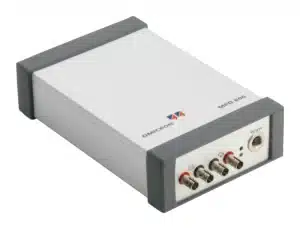
The MPD 600 is a modular, high-precision partial discharge (PD) measuring system developed by OMICRON for insulation testing and condition assessment …

$700/day, 1 to 7 days
$442/day for 29 to 90 days
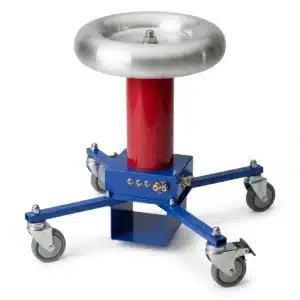
The MCC210 100 kV Coupling Capacitor is a high-voltage test accessory designed for use with partial discharge (PD) measurement and tan delta (TD) test…
$295/day, 1 to 7 days
$185.85/day for 29 to 90 days
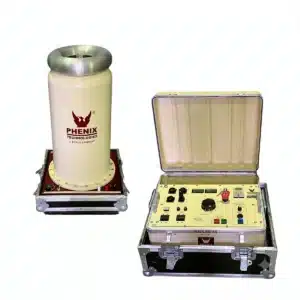
The BK130 High Voltage Withstand Test Set is a portable AC dielectric test system capable of generating up to 130 kV at 50 mA (5 minute duty), 33.3 mA…
$375/day, 1 to 7 days
$236.25/day for 29 to 90 days
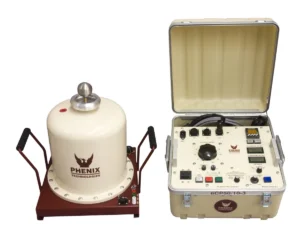
The 6CP50 High Voltage Withstand Test Set is a portable 50 kV AC test system designed for performing dielectric withstand (hipot) testing on cables, s…
$295/day, 1 to 7 days
$185.85/day for 29 to 90 days

The Ultratev Plus² by EA Technology is a portable, non-intrusive test instrument for detecting and analysing partial discharge (PD) activity in medium…
$285/day, 1 to 7 days
$179.55/day for 29 to 90 days
Calibration
All Megavar test equipment is maintained under a documented calibration programme. Instruments are calibrated either by external calibration laboratories or in-house against reference standards that are themselves laboratory-calibrated, with measurement traceable to Australian national measurement standards held by the National Measurement Institute. A current calibration certificate is available on request. If your project requires a specific calibration interval, test standard, or documentation for a client submission, tell us at enquiry on 1300 730 499 and we will confirm what applies before you commit.
EA Technology
Phenix
SUTE / Wuhan Sute
Get a quote for Partial Discharge equipment hire
Online surveys and offline IEC 60270 measurement. Australia-wide delivery.
Tell us what you need and when, and we will come back with availability and pricing.
About partial discharge testing equipment hire
Partial Discharge Testing Equipment hire, in more detail
Introduction
Partial discharge is the small, localised electrical breakdown that occurs in regions of an insulation system where the local electric stress exceeds the dielectric strength of the material. Voids in epoxy, defects in cable joints, contamination on switchgear bushings, water trees in cable insulation and floating particles in GIS will all generate measurable PD long before they cause an outright failure. PD testing detects, quantifies and locates these defects, and is widely accepted as the leading indicator of insulation-system condition on transmission and distribution assets.
Two broad measurement approaches are in use. Conventional PD measurement per IEC 60270 detects pulse currents through a coupling capacitor, expresses results in picocoulombs and is the reference method for type tests, factory acceptance tests and offline site measurements. Non-conventional methods covered by IEC TS 62478 use acoustic, transient earth voltage (TEV) and ultra-high-frequency (UHF) sensors to detect PD on energised assets without de-energisation. Both approaches are represented in the Megavar hire fleet, with Omicron’s MPD 600 platform covering IEC 60270 conventional measurement and EA Technology’s UltraTEV Plus² covering online TEV and ultrasonic surveys.
Cable PD testing is governed by IEEE 400.3 and IEC 60885-3, transformer PD testing falls under IEC 60076 series, GIS PD testing under IEC 62271-203, and rotating machine PD testing under IEC 60034-27 series. Megavar’s commissioning engineers perform PD measurement against these standards on transmission and distribution networks every month, including on BESS step-up transformers, transmission GIS, distribution switchgear surveys and HV motor stator windings. Hire from our offices in Hobart, Launceston, Adelaide and Newcastle, with delivery Australia-wide.
PD Testing Applications and Standards
PD testing is applied across the major HV asset classes, with measurement methods adapted to the asset type and the test scenario.
Switchgear and substation surveys
Online PD surveys on energised MV and HV switchgear use a combination of TEV (transient earth voltage), airborne ultrasonic and contact ultrasonic sensors. The walkaround survey is non-invasive, takes a single shift on a typical substation, and identifies the panels and cubicles where PD activity warrants further investigation. The EA Technology UltraTEV Plus² is a recognised industry standard for this work in Australia and worldwide.
Cable joint and termination diagnostics
Offline PD measurement on cables is normally combined with a VLF or AC resonant withstand test, providing both an acceptance result and a sensitive diagnostic in a single site visit. The PD measurement system synchronises with the test voltage waveform to produce a phase-resolved partial discharge (PRPD) pattern, which an experienced diagnostic engineer interprets to localise activity to a joint, termination or insulation defect. IEEE 400.3 and IEC 60885-3 set out the test methods.
Transformer factory acceptance and site testing
PD measurement on transformers is required by IEC 60076 during factory acceptance and is performed at site after major works such as rewinds or relocations. Offline measurement uses the conventional IEC 60270 method with coupling capacitors at each high-voltage bushing. UHF measurement using internal couplers or oil-valve-mounted sensors complements the conventional method on large transformers and is increasingly specified on transmission-class units.
GIS commissioning and condition assessment
Gas-insulated switchgear is PD-tested at FAT and at site commissioning per IEC 62271-203. UHF PD measurement is the dominant method on GIS because the wave structure of the GIS itself acts as a low-loss waveguide for PD signals at UHF frequencies, allowing detection of defects that would not be visible to conventional measurement. Megavar performs UHF PD measurement on GIS commissioning projects using the MPD 600 platform with UHF couplers.
Rotating machine stator winding tests
PD measurement on HV motor and generator stator windings, governed by the IEC 60034-27 series, is one of the most useful tools for assessing winding insulation condition between major overhauls. Online PD measurement using stator slot couplers is a long-running asset management practice on large machines; offline PD measurement during a planned outage gives a more controlled measurement environment with the stator de-energised and the test voltage applied in steps.
Online versus Offline PD Measurement
PD testing is split between two distinct operating modes, and the right method depends on what you are trying to learn and what access the asset permits.
Online PD measurement
Online measurement is performed with the asset energised and in service, using non-conventional sensors that do not require electrical connection to live parts. TEV and ultrasonic sensors detect PD activity through the metallic enclosure or by airborne acoustic coupling. Online measurement is the standard approach for survey-based asset management programmes because it requires no outage, no de-energisation and no scheduling negotiation with operations. The trade-off is that quantitative comparison against IEC 60270 acceptance limits is not possible and the result is always interpreted as a relative indicator of activity rather than an absolute pC measurement.
Offline PD measurement
Offline measurement is performed with the asset de-energised and an external test voltage applied through a controlled HV source. The conventional IEC 60270 method gives a quantitative result in picocoulombs, comparable across measurements and against published acceptance limits. Offline measurement is required for type tests, factory acceptance tests, after-laying cable acceptance tests and any project specification that calls for compliance with IEC 60270. The trade-off is the outage cost, the additional planning, and the requirement for a calibrated HV source matched to the asset under test.
When to Hire vs Buy
PD testing equipment sits at the most specialised and expensive end of the HV diagnostic fleet. Even tier-one Australian utilities frequently hire rather than buy, because measurement competency is more critical than equipment ownership and the equipment becomes obsolete faster than equivalent withstand test sets.
Hire from Megavar when...
- You need offline conventional PD measurement on a single project
- You need an online PD survey carried out by experienced operators
- Your team has not been trained on PD pattern interpretation
- You need transformer or GIS PD measurement with UHF couplers and supporting accessories
- The diagnostic outcome matters more than equipment ownership
- You want results interpreted by engineers who measure PD every month
Consider purchasing when...
- Your team performs PD surveys as a routine asset management activity
- You have qualified PD engineers in-house with current measurement competencies
- Your network covers more than 50 distinct PD measurement locations per year
- You can commit to ongoing manufacturer training and software updates
- Your asset register justifies a multi-year diagnostic programme
- Your organisation can absorb 3 to 5 year obsolescence on the measurement platform
Why Hire from Megavar
PD testing is one of the most demanding HV diagnostic disciplines. Equipment ownership is necessary but not sufficient. The measurement is only useful if the operator can identify a calibration drift, recognise a noise source on a busy substation site, distinguish PRPD signatures of corona, surface tracking and internal voids, and translate the result into a clear maintenance recommendation. Megavar’s commissioning engineers do this work every month on transmission and distribution projects.
When you hire PD testing equipment from Megavar you receive: current calibration with traceable certificates, the matched coupling components for the asset class you are testing, and the manufacturer's manuals. Where the project requires the measurement and interpretation done end-to-end rather than equipment alone, we can quote a turnkey diagnostic service. This is the most common arrangement for offline cable PD work, transformer site PD, GIS commissioning PD, and stator winding PD measurement.
Hire periods are flexible from a single-day online PD survey through to multi-month offline measurement campaigns. Delivery is Australia-wide. Call 1300 730 499 or email rentals@megavar.com.au.
Before you get to site
Partial Discharge Testing Explained: Methods, Standards and What the Results Mean
A Megavar field guide to the test: what it proves, how it is set up and how to read the result.

How the hire works
Hire terms in brief
After you enquire
We confirm availability, rates and freight in a written quote, valid for the period it states (usually 14 days). An enquiry or quote does not reserve equipment: the hire is booked when your purchase order, signed quote or email acceptance reaches us.
Hire period
Our carrier: up to 72 hours of transit each way is not charged as hire. Hire starts at delivery or 72 hours after dispatch, whichever is earlier, and ends at handover to our carrier or 72 hours before the equipment arrives back, whichever is later. Delay caused by us or our carrier is not charged. For example, dispatched Monday 10am and delivered Wednesday 2pm: hire starts Wednesday 2pm. Routes that normally take longer than 72 hours are marked on the quote. Your own freight: hire runs from handover to your carrier at our office until the equipment arrives back at our office. Collect in person: from collection to return.
Extensions and early return
Contact us before the return deadline to extend; your quoted rates stay fixed and extended hire is invoiced every 7 days. Return early and you pay only for the days used, at the rate band for the days actually hired.
Delivery and returns
Freight for each leg, the handling fee and any express dispatch are on the quote, before you accept. Returns go to the dispatching office named on the quote, by carrier or in person, never by post.
Counter times
Returned to our counter before 9am on a business day counts as the previous day. Collected after 4pm on a business day, hire starts the next day. Weekends and public holidays count as hire days.
Calibration and checks
Supplied in working order with listed accessories, leads and manuals. Each measuring instrument is calibrated, and its current NATA-traceable calibration certificate is available on request. If calibration falls due during your hire, we tell you before dispatch.
Cancelling or moving a booking
Cancel 5 or more business days before dispatch or collection and nothing is charged. With 2 to 4 business days’ notice, the charge is the greater of one day’s hire and 5% of the booked hire; with less notice, the greater of one day’s hire and 10%. You can ask once to move the start by up to 30 days, with at least 2 business days’ notice.
Loss, damage and insurance
The equipment is your responsibility, other than fair wear and tear, from the start of hire until it is back with us, including in transit, up to the replacement value cap shown on the quote for each item. No damage waiver is offered. We recommend you insure the equipment for its replacement value.
Payment and bond
Account customers pay each invoice within 14 days. Without a credit account, or paying by card, you pay the booked hire, freight, handling fee and any bond before dispatch. A bond applies only where the quote states one, and is refunded after return and inspection, less anything owed.
Summary of our Terms and Conditions: Test Equipment Hire. Full hire terms
Enquire about Partial Discharge Equipment Hire
Check availability
Send your hire dates and delivery location and we will confirm availability and lead time by the end of the next business day.
Or call us directly on 1300 730 499
Need help with your rental?
1300 730 499 We’re available Monday to Friday, 8:30 am to 5:00 pm. Urgent hire: call rather than send the form. rentals@megavar.com.auFAQ
Frequently Asked Questions for Partial Discharge Equipment
What is partial discharge testing?
Partial discharge testing detects, measures and locates the small localised electrical breakdowns that occur in HV insulation systems before they develop into outright failures. PD activity is the leading indicator of insulation degradation in cables, transformers, switchgear, GIS and rotating machines, and PD testing is widely considered the most sensitive non-destructive diagnostic available for HV assets. Both quantitative offline measurement (per IEC 60270) and qualitative online surveys (per IEC TS 62478) are recognised methods.
What is the difference between online and offline PD testing?
What equipment is needed to perform PD testing?
For online surveys on energised switchgear and transformers, a handheld TEV and ultrasonic instrument such as the EA Technology UltraTEV Plus² is sufficient for a walkaround survey. For offline IEC 60270 measurement, you need a measurement system (Omicron MPD 600 or equivalent), a coupling capacitor matched to the test voltage and asset class (such as the MCC 210), an HV test source (a VLF set, AC resonant set, or AC dielectric test set depending on the asset and applicable standard), and the appropriate coupling and earthing accessories. The exact configuration depends on the asset under test and the specification.
What standards apply to partial discharge testing?
The reference standard for conventional offline PD measurement is IEC 60270. Asset-specific standards build on this: IEEE 400.3 and IEC 60885-3 for cables, IEC 60076 series for power transformers, IEC 62271-203 for GIS, and the IEC 60034-27 series for rotating machines. IEC TS 62478 covers non-conventional measurement methods including acoustic, TEV and UHF. AS/NZS standards reference IEC 60270 directly for most Australian applications.
Can you survey a substation while it is in service?
Yes. Online PD surveys are performed on energised substations using TEV and ultrasonic sensors that do not require electrical connection to live parts. A typical MV switchroom survey can be completed in a single shift, with results presented as a panel-by-panel risk indicator and recommendations for follow-up. Online surveys are the standard approach for survey-based asset management programmes because they require no outage and can be scheduled with minimal disruption to operations.
How is partial discharge measured in picocoulombs?
The IEC 60270 method captures the PD pulse current as a small charge transfer in the test circuit, then integrates and calibrates it against a known charge injection so that the result is expressed as an apparent charge in picocoulombs. The measurement system applies bandpass filtering to suppress noise and synchronises to the applied test voltage so that PD pulses can be plotted on a phase-resolved partial discharge (PRPD) pattern. The PRPD pattern is the primary output that an experienced diagnostic engineer uses to identify the type and likely location of PD activity.
Can Megavar provide a turnkey PD testing service rather than just the equipment?
Yes. Megavar provides full PD diagnostic services using the equipment in this rental fleet, including measurement, PRPD pattern interpretation, defect classification and a written diagnostic report. This is a common arrangement for offline cable PD work, transformer site PD, GIS commissioning PD and rotating machine stator PD measurement. Contact us with the asset class, voltage level and project schedule and we will quote a complete scope.
How does Megavar handle offline PD testing on transmission cables?
Do you deliver PD testing equipment Australia-wide?
Explore Rental Categories
Explore Our Services
Partial discharge testing for HV cables, switchgear, transformers, and GIS across Australia. Online and offline PD identifies insulation defects before failure.
HV cable testing: VLF withstand, partial discharge, DC insulation, sheath integrity, and fault location for XLPE and PILC cables 11kV to 220kV across Australia.
HV substation maintenance across Australia. Preventive and condition-based programmes, protection testing and switchgear servicing from five offices.
Trusted by top enterprises for exceptional results


Testing guides
Related testing guides
Partial Discharge Testing Explained: Methods, Standards and What the Results Mean
Partial discharge testing finds insulation defects in HV cables, switchgear and transformers before they fail. This guide explains partial discharge detection, the difference between offline and…
Hipot Testing: A Field Guide to HV Withstand Testing of Switchgear, GIS and Bushings
Hipot testing applies a voltage well above the operating voltage to insulation for a set time to prove it withstands it. This guide explains AC, resonant…
VLF Cable Testing: A Field Guide to VLF Withstand, Tan Delta and Sheath Testing
VLF testing applies AC at 0.1 Hz to an MV or HV cable to prove its insulation, joints and terminations. This guide explains the withstand levels…