
Testing and commissioning services
HV Substation Commissioning Services Australia
Talk to an engineer: 1300 730 499 or service@megavar.com.au
| Field | Megavar |
|---|---|
| Service range | 11 kV to 500 kV |
| Delivery contexts | Greenfield substations, brownfield augmentations and staged replacements in live substations |
| Standards | Applicable Australian and international standards, plus project and network service provider commissioning requirements |
| Test equipment | OMICRON-based fleet, calibrated with certificates traceable to national standards |
| Coverage | Australia-wide from offices in Hobart, Launceston, Adelaide, Newcastle and Gladstone |
| Deliverable | Signed commissioning test records, readiness recommendation at each hold point and the commissioning records package for handover |
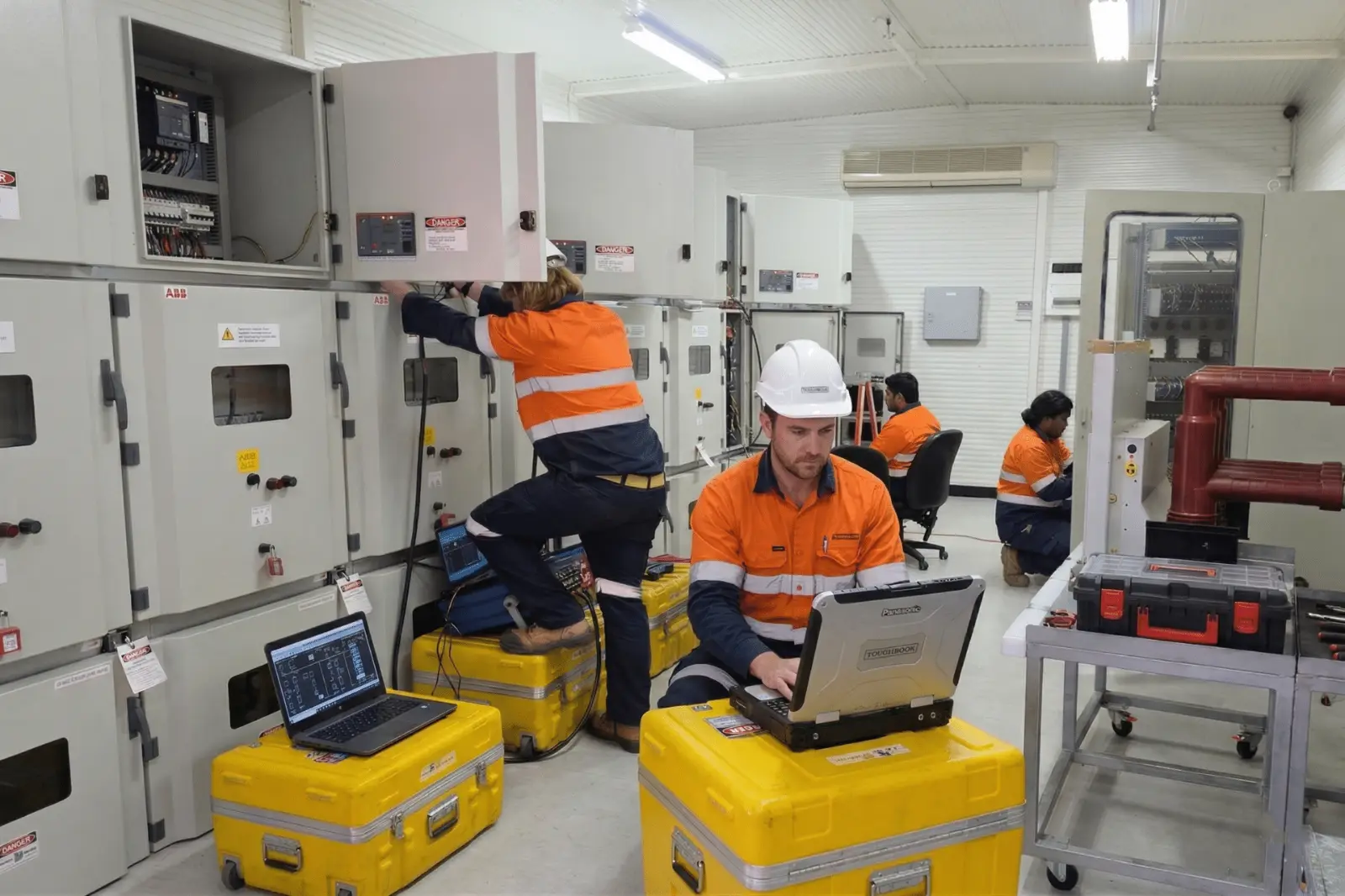
What is substation commissioning?
Independent HV commissioning
Who engages Megavar to commission a substation?
How Megavar commissions a substation
Phase 1: Pre-commissioning and design review
- Design review: single line diagrams, protection schematics, SCADA architecture, wiring diagrams, cable schedules and settings documents checked against the specification and the connection agreement.
- Commissioning plan: commissioning procedures, inspection and test plans, hold-point schedule and risk assessment developed and submitted for approval.
- Factory acceptance follow-up: factory acceptance test (FAT) results reviewed, non-conformances tracked to closure, site acceptance test (SAT) scope confirmed. Megavar can also run the factory acceptance tests.
Phase 2: Component testing
- Power transformers: transformer testing covering turns ratio, DC winding resistance, insulation resistance, tan delta, excitation current and vector group verification to AS 60076 and IEC 60076; sweep frequency response analysis; and baseline dissolved gas analysis, with oil sampled on site and analysed by a laboratory.
- Switchgear and circuit breakers: contact resistance, insulation resistance, timing and travel, and operation counter checks to IEC 62271; SF6 pressure and gas quality on SF6-insulated plant.
- Protection relays: protection relay testing by secondary injection of each function enabled in the approved settings (overcurrent, directional, differential, distance, under and over voltage, frequency, breaker fail, auto-reclose, synchronism check), with settings verified against the approved schedule.
- Current transformers: ratio, polarity, excitation (magnetisation) curve, winding resistance and burden.
- Voltage transformers: ratio, polarity, insulation resistance and secondary circuit checks.
- Current loops: primary injection to prove the CT circuits in scope from the primary conductor through to the relay, as distinct from the protection scheme tests in Phase 3.
- HV cables: insulation resistance, VLF withstand where specified, sheath integrity and phasing.
- Earthing: earthing grid resistance, step and touch potentials, continuity, and earth fault loop impedance on the LV auxiliary circuits.
- DC systems: battery, charger, distribution, changeover, UPS and trip circuit supervision.
Phase 3: System integration testing
- SCADA and communications: SCADA commissioning with point-to-point verification of every status, control, analogue and alarm in the installed scope; DNP3, IEC 61850 and Modbus protocol testing; alarm propagation to the network control room, and the telemetry and interface tests the connection agreement requires for AEMO where they apply.
- IEC 61850: GOOSE messaging between intelligent electronic devices (IEDs), SCL (Substation Configuration Language) file validation, MMS (Manufacturing Message Specification) reporting to SCADA and data model confirmation across IEDs from different manufacturers.
- Protection scheme logic: intertripping, permissive schemes, busbar zone selection, breaker fail backup, auto-reclose sequences and load shedding tested end to end as complete schemes.
- Interlocking: electrical and software interlocks proved for the switching scenarios in the approved operating philosophy, including key exchange systems.
Phase 4: Energisation support and handover
- Energisation support: Megavar engineers on site through staged HV energisation, transformer and bus energisation, and load transfer, with on-load checks of protection currents, phase angles and directionality. Switching is carried out under the network operator's or asset owner's authority.
- Soak period: post-energisation monitoring through the initial operating period.
- Handover: the commissioning records package, which includes all test records, as-found and as-left settings and non-conformance closures. Design and wiring errors found during commissioning are marked up and returned to the designer for the final as-built design; producing the as-built drawings themselves is included where it is in Megavar's contracted scope.
Substation commissioning management
Selected substation commissioning projects
Megavar's published commissioning case studies cover transformer replacements, live-substation switchgear replacement, switchyard augmentation and the HV plant of utility-scale battery energy storage systems. The project rating and the network connection voltage are context; the Megavar scope column is what Megavar tested and commissioned.
Case study: 22 kV switchgear replacement, design and commissioning
| Project | Client | Megavar scope | Status |
|---|---|---|---|
| St Marys 110/22 kV transformer replacement, Tasmania | TasNetworks | Primary, secondary and SCADA design plus testing and commissioning of two 10 MVA transformers and the 22 kV protection | Complete |
| Chapel Street Substation, Tasmania | RBD Electrical for TasNetworks | Commissioning of four replacement 11 kV bus sections (ABB UniGear ZS1), one bus at a time with the substation in service, including SCADA integration | Complete |
| Rosebery 44 kV disconnector upgrade, Tasmania | Zinfra for TasNetworks | Testing and commissioning of the replacement disconnectors and the associated protection upgrades, installed by Zinfra, in a live switchyard within controlled outage windows | Complete |
| Mornington BESS, Victoria (240 MW / 480 MWh) | ACLE Services | 33 kV gas-insulated switchgear, protection, SCADA and battery discharge testing; connection at AusNet's Tyabb Terminal Station | Complete |
| Pine Lodge BESS, Victoria (250 MW / 590 MWh) | ACLE Services | Commissioning management plus testing and commissioning of the HV plant | In progress; current status on the project page |
| Bluegrass BESS, Queensland (60 MW / 120 MWh) | ACLE Services | Factory and site acceptance testing, protection commissioning and earth testing of the 33 kV plant; the project connects to Powerlink's 132 kV network | Complete |
Substation commissioning voltage range
| Voltage class | Typical assets | Typical client types |
|---|---|---|
| 11 kV to 33 kV | Distribution switchboards, zone substations, BESS and solar farm collector systems, industrial HV distribution | Distribution networks, EPC contractors, developers, industrial operators |
| 44 kV to 132 kV | Zone and sub-transmission substations, transformer replacements, switchyard augmentations | Transmission and distribution networks, principal contractors |
| 220 kV to 500 kV | Transmission substations, grid connection points, synchronous condenser and large generator connections | Transmission networks, EPC contractors, generators |
Substation commissioning test equipment
| Test purpose | Instruments |
|---|---|
| Protection relay secondary injection and IEC 61850 GOOSE signal verification | OMICRON CMC 356 |
| Primary injection and current loop proving | OMICRON CPC 100 |
| Transformer ratio, winding resistance and excitation tests | OMICRON CPC 100 |
| Current transformer testing | OMICRON CT Analyzer |
| Circuit breaker timing, travel and contact resistance | OMICRON CIBANO 500 |
| Partial discharge | OMICRON MPD 600 |
| Insulation resistance | Megger insulation testers |
Where Megavar commissions
Megavar's commissioning engineers and managers
Each Megavar commissioning project is led by one of a small team of commissioning managers, each with a background in HV site testing, who holds the commissioning programme, the hold-point schedule and the client interface from pre-energisation planning through to handover. The test teams are Megavar engineers and testers working to the commissioning plan. The same engineering group produces Megavar's primary, secondary and SCADA designs, so the commissioning engineers review protection schematics and settings as designers as well as testers. Megavar was founded in 2003, holds ISO 9001, ISO 14001 and ISO 45001 certification, and holds electrical contractor licences in every Australian state.
Why Choose Megavar For HV SUBSTATION COMMISSIONING?
- Independent commissioning – We don’t build it and then mark our own work. Independent commissioning provides unbiased quality assurance.
- 20+ years’ experience – Hundreds of substations commissioned across every voltage class and configuration.
- Omicron test platform – The industry standard for modern digital protection and control testing.
- National coverage: offices in Tasmania, South Australia, New South Wales and Queensland.
- ISO 9001, 14001, 45001 – Quality, environmental, and safety management systems certified.
- Electrical contractors licences: Licensed in every Australian state.
Ready to commission your substation? Contact Megavar today on 1300 730 499 or visit our contact page to request a quote.
Explore Our other services
Substation Maintenance
Substation Design & Audit
Whether you’re dealing with the intricacies of electrical design, power system modelling, or the need for thorough auditing services, we provide solutions to address your specific challenges and enhance the reliability and efficiency of your power systems.
Test Equipment Rental
Access Top-of-the-Line Power System Testing Equipment
Explore our extensive rental inventory of specialised tools and versatile testing solutions. We provide everything you need to ensure your power systems operate efficiently and reliably.
Take it to your team


Clients
What our clients say
The Megavar team demonstrate professionalism and excellence in all aspects of HV electrical commissioning. It’s great to work with the team with the high standards of quality and safety that you would expect when dealing with complex high voltage installations, the experienced Megavar team has been exactly what was needed for project delivery.
Megavar are industry leaders in HV commissioning services, offering high quality commissioning services. They are experts in high voltage commissioning services, and their work is always on time, on budget and to the highest quality.
FAQ
Frequently asked questions about HV substation commissioning
What does HV substation commissioning involve?
HV substation commissioning involves testing the primary and secondary components in the installed scope individually, then proving the substation as an integrated system before it is energised. Components include power transformers, switchgear and circuit breakers, protection relays, current and voltage transformers, cables, earthing, DC systems, SCADA, communications and interlocking. The work runs in four phases: pre-commissioning and design review, component testing, system integration testing, and energisation support and handover.
What are the steps in substation testing and commissioning?
Substation testing and commissioning runs in four steps: pre-commissioning and design review, component testing of each item of plant, system integration testing of the protection, SCADA and interlocking schemes, and energisation with on-load checks and handover. The same sequence applies to electrical testing and commissioning at any HV voltage; the tests selected within each step depend on the plant and the network's requirements.
What tests are required to commission a power transformer?
Commissioning a power transformer typically includes turns ratio, DC winding resistance, insulation resistance, tan delta, excitation current and vector group verification, sweep frequency response analysis as a baseline, and dissolved gas analysis of an oil sample, followed by protection and alarm checks on the transformer's own devices and on-load checks after energisation. The approved commissioning plan sets which tests apply to a given unit.
What is the difference between HV testing and commissioning?
High voltage testing proves an individual item of plant meets its specification, for example a transformer's turns ratio or a breaker's timing. Commissioning proves the whole substation works as designed: the protection operates the right breakers, the SCADA reports the right points, the interlocks hold, and the site can be energised and handed over. Testing is one input to commissioning.
What voltage classes does Megavar commission?
Megavar's commissioning service covers 11 kV distribution through to 500 kV transmission. Megavar works daily on ElectraNet's 330 kV transmission network, including remedial action schemes and control schemes for renewable energy and data centre connections. Published case studies cover 11 kV, 22 kV, 33 kV, 44 kV and 110 kV plant.
How long does substation commissioning take?
Substation commissioning duration depends on size, voltage class, protection and SCADA complexity and outage access. As a guide to elapsed site commissioning time with one test team on day shift, a 33 kV two-transformer zone substation may require two to three weeks, and a 275 kV transmission substation with multiple bays, busbar protection and IEC 61850 communications may require eight to twelve weeks. Both assume construction is complete, settings are approved and outages are available when planned. Staged works on a live substation, such as the Chapel Street bus replacement, run over months because each stage waits on an outage window.
How much does substation commissioning cost?
Substation commissioning cost depends on the number of bays and plant items, the voltage class, the protection and SCADA complexity, whether factory acceptance testing is included, and how many outage windows the work must fit into. Megavar quotes from the single line diagram, protection schematics and the commissioning scope. Call 1300 730 499 or email service@megavar.com.au with the drawings for a quote.
Why use an independent commissioning engineer?
An independent commissioning engineer tests and records the installation without having built it, so the construction contractor's work is verified by a separate party with its own test records. Commissioning and witnessing arrangements follow the relevant network service provider's procedures, and an independent commissioning team is set up to meet them.
What is IEC 61850 commissioning?
IEC 61850 commissioning verifies the digital communications in a substation: GOOSE messaging between intelligent electronic devices, MMS reporting to SCADA, the SCL configuration files and the data model, across devices from different manufacturers. Megavar verifies GOOSE signal exchange and reporting functionally with OMICRON CMC test sets and confirms every signal in the installed scope end to end.
Does Megavar do solar farm, wind farm and BESS HV commissioning?
Megavar commissions the HV infrastructure of battery energy storage systems, solar farms and wind farms: depending on the project scope, the collector switchgear, step-up transformers, protection, SCADA and grid connection. Published case studies cover Mornington BESS, Pine Lodge BESS and Bluegrass BESS. See the BESS commissioning service page for that scope in detail.
Does Megavar provide commissioning management as well as testing?
Megavar provides substation commissioning management, which covers the commissioning programme, hold-point schedule, network operator interfaces, outage planning and readiness reviews. Megavar provides it on its own or combined with the testing scope, as at Pine Lodge BESS for ACLE Services.
Which test equipment does Megavar use?
Megavar commissions with its own OMICRON-based fleet, calibrated and traceable to national standards. The equipment table on this page maps each instrument to the tests it is used for.
Ready to commission your substation? Call Megavar on 1300 730 499 or email service@megavar.com.au with the single line diagram and scope, and a commissioning engineer will come back to you with a quote. You can also request a quote through the contact page.
Request a quote
Tell us about the job
An engineer replies by the end of the next business day (Monday to Friday, 8:30 am to 5:00 pm). Scope still forming? Send what you have. Outage or urgent fault? Call to discuss the site, access window and mobilisation.
Talk to us now
1300 730 499 service@megavar.com.au Hobart · Launceston · Adelaide · Newcastle · GladstoneExplore Our other services
HV earthing design and testing. Earth grid design, soil resistivity, injection testing and step and touch surveys for substations across Australia.

SCADA and RTU commissioning for substations and renewables. Point-to-point testing, protocol integration and HMI verification by Megavar engineers.
Protection relay testing and secondary injection across Australia. Schemes proven to specification by Megavar's commissioning engineers. Enquire today.
Trusted by top enterprises for exceptional results


Testing guides
Related testing guides
Secondary Isolation: CT Shorting Links, Test Blocks and Trip Isolation for Protection Testing
Secondary isolation separates the protection, control and metering circuits under test from the circuits that stay in service. This guide sets out the principles: CT shorting…
Power Quality Testing: A Field Guide to Logging and Analysis at the Point of Connection
Power quality testing logs voltage and current at a point of connection for days and analyses the record for voltage, unbalance, harmonics, flicker, dips, swells, interruptions…
Thermal Imaging: A Field Guide to Thermography of Switchboards, Switchgear and Substation Plant
Electrical thermal imaging finds connections, contacts and components running hotter than they should, on energised plant, without touching it. This guide explains what the image can…