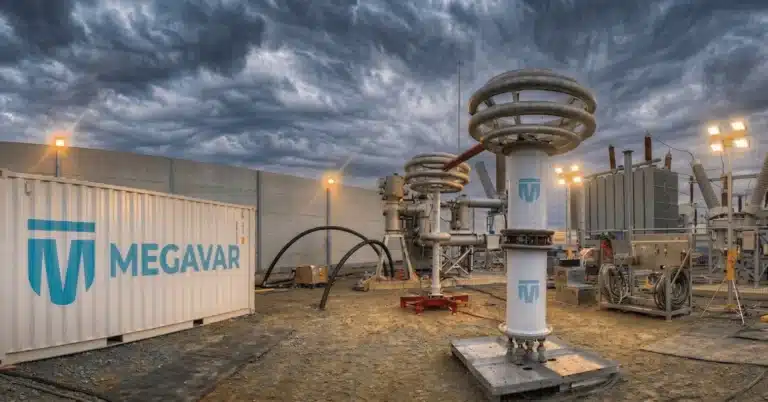
Resonant Hipot Testing Services Australia
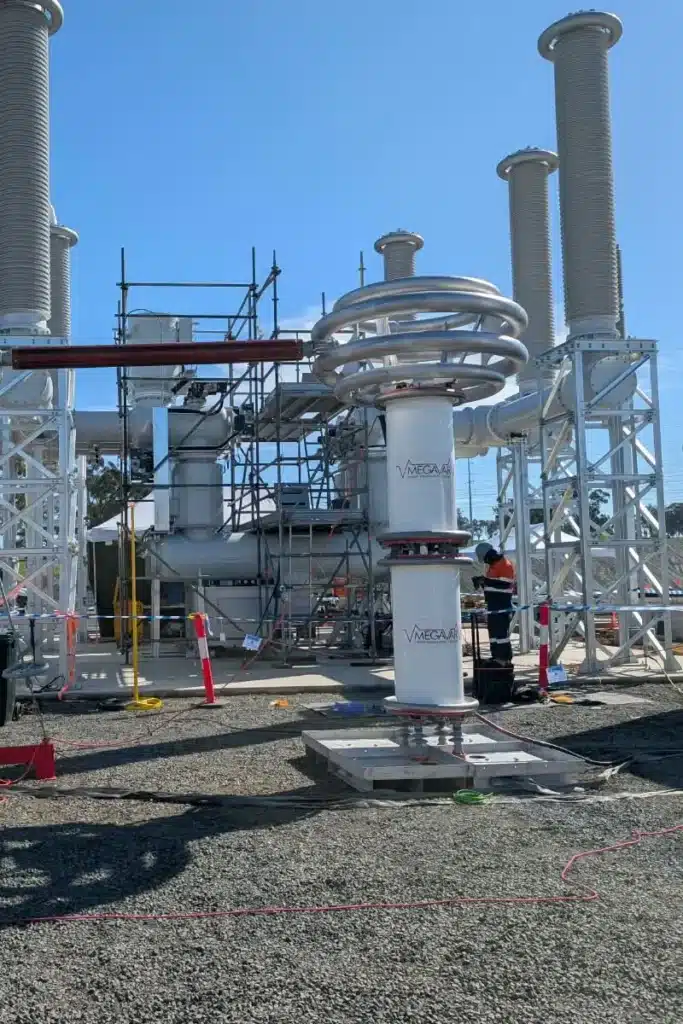
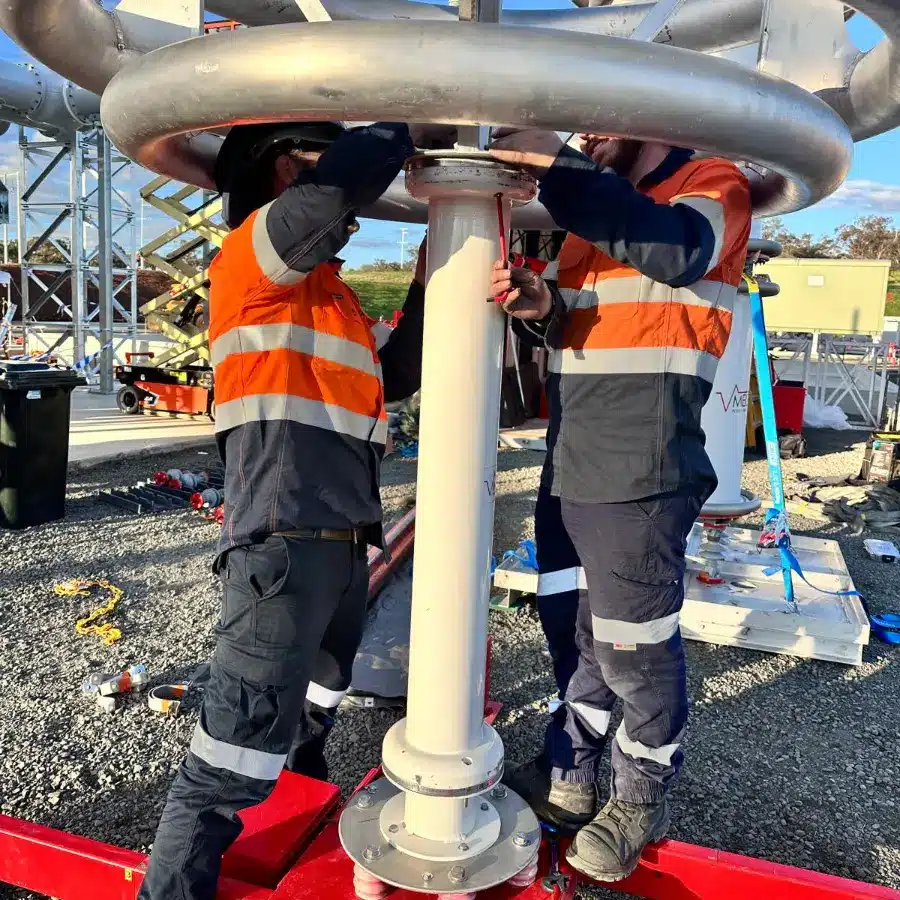
Megavar provides on-site resonant hipot testing, the power frequency HV withstand test of installed high voltage insulation, for HV and EHV cables, gas-insulated switchgear (GIS), power transformers, shunt reactors and instrument transformers. Megavar owns and operates two variable-frequency resonant test sets, rated 300 kV and 500 kV, and runs them with its own commissioning engineers, measuring partial discharge during the withstand where the specification calls for it. The 500 kV set travels in a 20-foot shipping container and the 300 kV set on Megavar’s 11-tonne truck, and both are erected on site to suit the yard layout and access. Before quoting, Megavar checks every test configuration against the capacitance of the item, so the client knows the test is achievable before anything is mobilised.
| Field | Megavar |
|---|---|
| Test voltage | Up to 500 kV AC, single phase |
| Test sets | Two Megavar-owned variable-frequency resonant sets: 300 kV and 500 kV |
| Frequency range | 25 to 300 Hz (300 kV set); 45 to 300 Hz (500 kV set, full voltage from 60 Hz) |
| Partial discharge | Measured to IEC 60270 during the withstand: Omicron MPD, or a specialist PD partner on transmission-class campaigns |
| Items tested | HV and EHV cable circuits, GIS, power transformers and shunt reactors, CTs, CVTs, VTs and disconnectors |
| Standards | IEC 60060-3, IEC 60840, IEC 62067, IEC 62271-203, AS/NZS 60076.3 and IEC 60270, with the asset owner’s specification |
| Delivery | Full test service or operated hire into your test programme, always run by Megavar engineers; not available for dry hire |
| Transport | 500 kV set: 20-foot shipping container. 300 kV set: Megavar’s 11-tonne truck. Both erected to suit the site |
| Coverage | From offices in Hobart, Launceston, Adelaide, Newcastle and Gladstone, across Tasmania, South Australia, Victoria, New South Wales and Queensland |
What is resonant hipot testing?
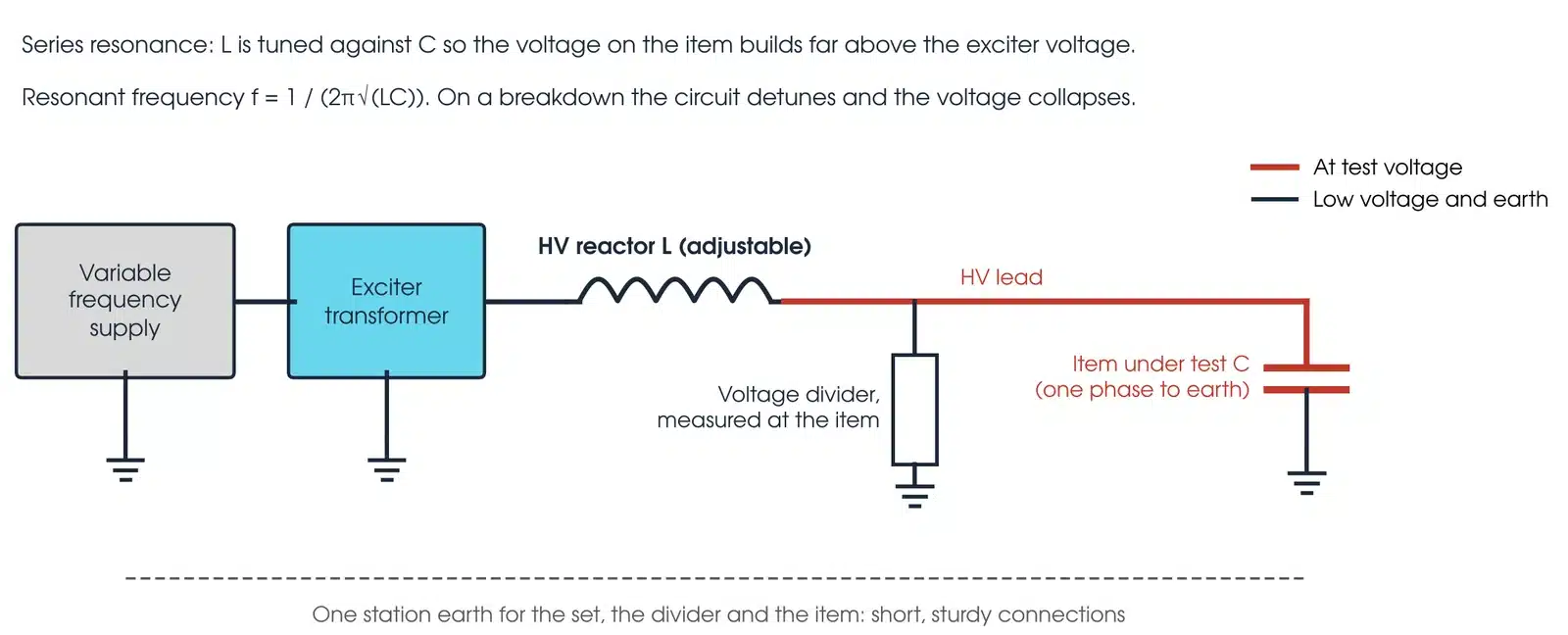
Resonant hipot (hi-pot or high pot) testing is an AC withstand test in which an adjustable reactor is tuned against the capacitance of the item under test, so the circuit resonates and the voltage on the item builds far above the voltage of the supply. Because the circuit is in resonance, the supply only provides the circuit losses, not the full reactive power of the test. That is what makes it practical to apply several hundred kilovolts, at close to power frequency, to a long cable or a GIS section on site from a 415 V supply. Hipot is short for high potential; the same test is also called an AC withstand test, a power frequency withstand test or a dielectric withstand test. The item passes if it holds the specified voltage for the specified time without a disruptive discharge.
How does a variable-frequency resonant set work?
A variable-frequency supply drives an exciter transformer, which feeds the high voltage reactor and the item under test in series. The circuit resonates at f = 1 / (2π√(LC)), where L is the reactor inductance and C is the capacitance of the item plus the voltage divider. The set searches for that frequency, then raises the voltage once the circuit is tuned, and the voltage is measured by a capacitive divider at the item. If the insulation breaks down, the circuit detunes and the voltage collapses, so the follow-through current is low and there is generally less damage to the item (AS/NZS IEC 60060.1:2026, 6.1.2.3; see our Hipot Testing Guide).
Why use resonant testing instead of VLF, DC or a test transformer?
Resonant testing is the method for high-capacitance items at HV and EHV: cables above 36 kV, GIS and large transformers, where the test must be AC at close to power frequency and the reactive power is too large for a conventional AC hipot set. Each source has its place.
| Method | How it works | Suited to | Limits |
|---|---|---|---|
| Resonant (25 to 300 Hz on Megavar’s sets) | Reactor tuned to the item’s capacitance; the supply provides only the losses | HV and EHV extruded cables, GIS, power transformers and reactors | Single phase; needs a crane and a 100 to 200 kVA supply; the configuration must suit the load capacitance |
| VLF (0.1 Hz) | Very low frequency AC, so a small set can charge a long cable | Medium voltage extruded cables; Megavar’s VLF sets reach 60 kV peak, for cables rated up to 36 kV | IEC 60840:2020 (clause 16.3) sets the after-installation AC test of HV cable at 20 to 300 Hz, which 0.1 Hz is well below |
| DC | Charges the item, then supplies only leakage current | Paper-insulated (PILC) cables | Not recommended for extruded (XLPE) insulation |
| Conventional AC hipot set (a step-up test transformer, such as the Phenix BK130 in mains mode) | Steps up a regulated mains supply to the test voltage; the supply must provide the full test kVA | Low-capacitance items such as switchgear, bushings and instrument transformers | The supply and the set grow with capacitance, so long cables and GIS are out of reach |
What Megavar tests with its resonant sets
Megavar uses its resonant sets for power frequency hipot testing of HV and EHV cables, gas-insulated switchgear, power transformers, shunt reactors and instrument transformers, after installation, repair, transport or relocation.
HV and EHV cable hipot testing
Megavar AC withstand tests extruded (XLPE) cable circuits with their joints and terminations, phase by phase, after installation. For cables above 30 kV, IEC 60840:2020 clause 16.3 sets the test at 20 to 300 Hz, at the Table 4 voltage for 1 hour or at U0 for 24 hours, or at a voltage and time the purchaser and contractor agree; IEC 62067 covers cables above 150 kV. This is the test that proves the joints and terminations made on site, which a factory test of the cable cannot. Partial discharge measured during the withstand locates a discharging joint or termination before the circuit is energised.
Transformer hipot testing: applied voltage and induced tests
A power transformer has two separate dielectric tests. The applied voltage test, also called the separate source AC withstand test, applies a test voltage from an external source to each winding with the other windings and the tank earthed, and proves the main insulation from that winding to earth and between windings (AS/NZS 60076.3:2017, clause 10). Megavar runs applied voltage tests on site with its resonant sets after transport, repair or relocation, typically for 60 seconds, at a test frequency not less than 80 per cent of rated frequency (40 Hz on a 50 Hz transformer).
The induced voltage test, also called the induced overpotential or induced overvoltage test, excites the transformer from its own winding above rated voltage, at a raised frequency so the core does not saturate, and stresses the turn-to-turn and phase-to-phase insulation. On site, Megavar’s approach for three-limb core transformers is the single-phase per limb method, energising one phase at a time with partial discharge measurement, offered case by case after engineering review of the transformer and the test level the manufacturer nominates. Where a specification calls for a three-phase induced test, Megavar says so at enquiry.
Switchgear and GIS hipot testing
Gas-insulated switchgear is withstand tested on site after assembly, at the specified gas pressure, sectioned to suit the capacitance of each test section (IEC 62271-203). Resonance suits GIS because its capacitance is large and the series circuit releases little energy if a particle or protrusion flashes over. Air-insulated and medium voltage switchgear has much lower capacitance, and Megavar tests it with smaller AC hipot sets from its HV testing equipment range. For medium voltage cables and other high-capacitance items up to 130 kV, Megavar also runs its Phenix BK130 as a series resonant set, driven by the variable-frequency output of an Omicron CPC 100.
Instrument transformers, reactors and disconnectors
CTs, CVTs, VTs, shunt reactors and disconnectors are withstand tested with partial discharge monitoring, either as part of a switchyard campaign or after repair.
Which voltage classes can Megavar test?
Australian transmission and subtransmission networks run at 66 kV, 132 kV, 220 kV, 275 kV, 330 kV and 500 kV. Megavar’s 500 kV set reaches the higher test voltages for GIS, transformers and short cable sections, and its 300 kV set carries the current for long cable circuits at the lower classes. Whether a given test is achievable depends on the test voltage the specification sets and the capacitance of the item or section, so Megavar confirms each configuration at enquiry.
Megavar's resonant test sets
Megavar owns two resonant test sets, chosen for different loads. The 300 kV set carries more current in parallel, so it suits cable circuits and other high-capacitance loads. The 500 kV set reaches the higher voltage, so it suits GIS, power transformers, reactors, switchyard plant and short lengths of EHV cable. Few contractors in Australia own resonant sets at these ratings; Megavar owns both of these and runs them with its own engineers.
| Specification | 300 kV set | 500 kV set |
|---|---|---|
| Manufacturer | SUTE (ST3598Z series) | Phenix Technologies |
| Maximum output | 300 kV, single phase | 500 kV, single phase, 1.5 MVA |
| Frequency | 25 to 300 Hz in series; 30 to 300 Hz in parallel | Full voltage from 60 to 300 Hz; reduced voltage down to 45 Hz |
| Reactor modules | Two 150 kV modules | Two 250 kV modules |
| Configurations | Series: 300 kV at 5 A (270 H). Single module: 150 kV at 5 A (135 H). Parallel: 150 kV at 10 A (67.5 H) | Series: 500 kV at 3 A. Single module: 250 kV at 3 A. Parallel: 250 kV at 6 A |
| Load capacitance | Up to 150 nF at 216 kV in series; up to 400 nF at 132 kV in parallel | 0.6 to 15.9 nF at 500 kV; 1.3 to 31.8 nF at 250 kV on one module; 2.5 to 63.7 nF at 250 kV in parallel; up to 113 nF at 187.5 kV (all including the voltage divider) |
| Source partial discharge | Not stated | Below 10 pC at rated voltage |
| Site supply | 400/415 V three phase, 100 kVA | 400/415 V three phase, 175 A (150 kVA generator minimum, 200 kVA preferred) |
| Transport | Megavar’s 11-tonne truck | 20-foot shipping container |
| Best suited to | Cable circuits and other high-capacitance loads | GIS, transformers, reactors, switchyard plant and short lengths of EHV cable |
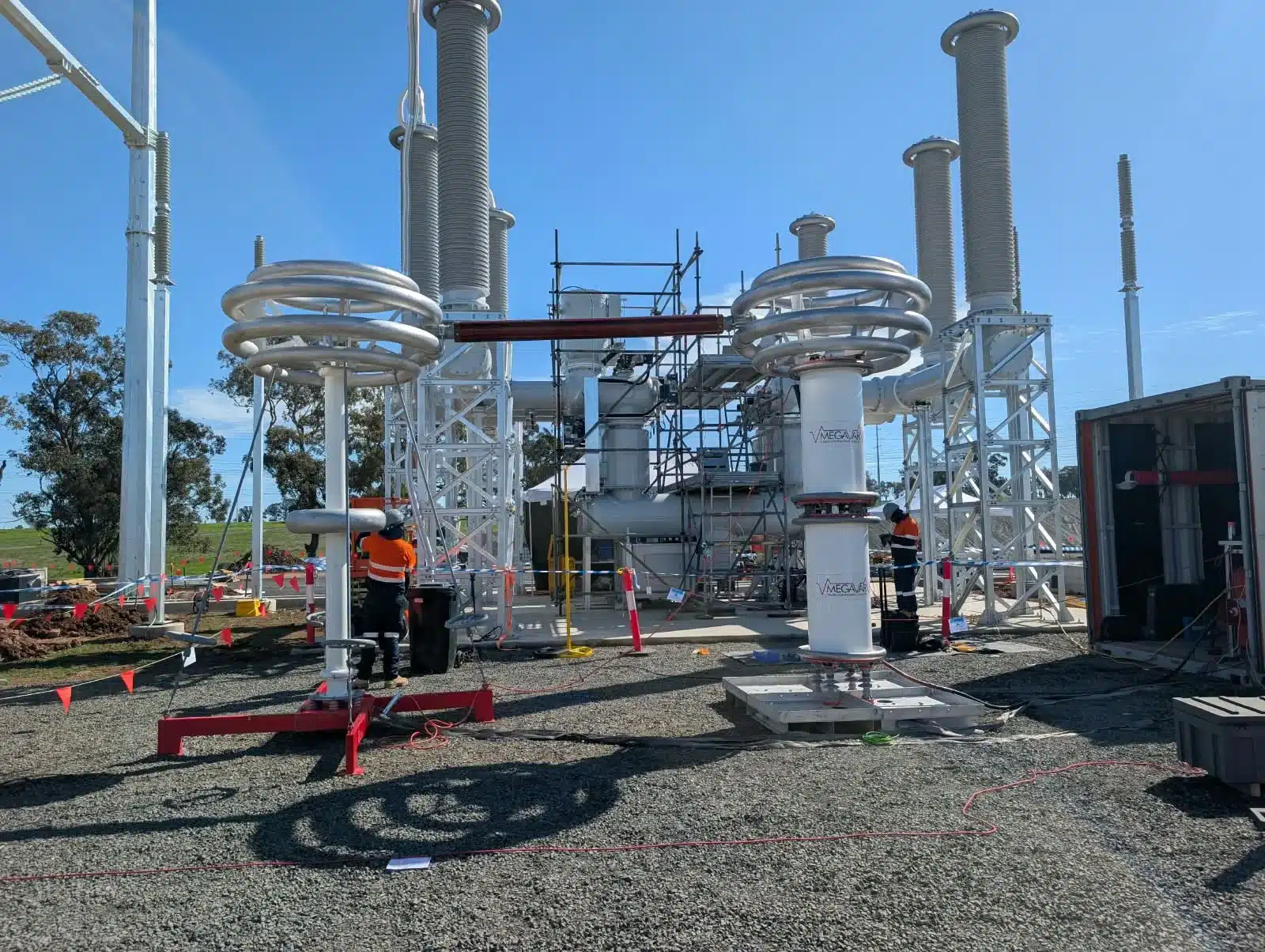
Both sets, the Phenix 500 kV HV Resonant Test Set and the SUTE 300 kV HV Resonant Test Set, are owned by Megavar and supplied only with Megavar’s test team.
How Megavar confirms a test is achievable
The test current is I = 2πfCU, where f is the resonant frequency, C the load capacitance and U the test voltage. For a given set, more capacitance means a lower resonant frequency and more current, until the frequency reaches the set’s lower limit or the current reaches its rating. Megavar runs this check at enquiry from the cable length and size, the section capacitance or the transformer’s factory test report. For example, 3.1 km of 240 mm² 110 kV XLPE cable at about 0.129 µF/km is about 0.40 µF. Tested at 132 kV on the 300 kV set in parallel (67.5 H), it resonates at about 30 Hz and the current is 2π × 30 × 0.40 µF × 132 kV, about 10 A, the set’s parallel rating. On the same basis, the 300 kV set in series (270 H) tests about 1.3 km of 400 mm² 220 kV cable (0.15 µF) at 216 kV, resonating at about 25 Hz and drawing about 5 A. A power transformer winding of 14.6 nF on one 135 H module resonates at about 113 Hz and draws about 1.2 A at 112 kV.
How Megavar runs a resonant withstand test
Megavar runs every resonant test to an inspection and test plan agreed with the asset owner, in seven steps.
- Configuration check at enquiry. Load capacitance, resonant frequency and current are checked against the set, so the test is known to be achievable before Megavar quotes.
- Inspection and test plan. The test circuit, voltage profile, hold points and exclusion zones are agreed before mobilisation. Test levels, durations and pass criteria come from the asset owner’s specification and the applicable standard.
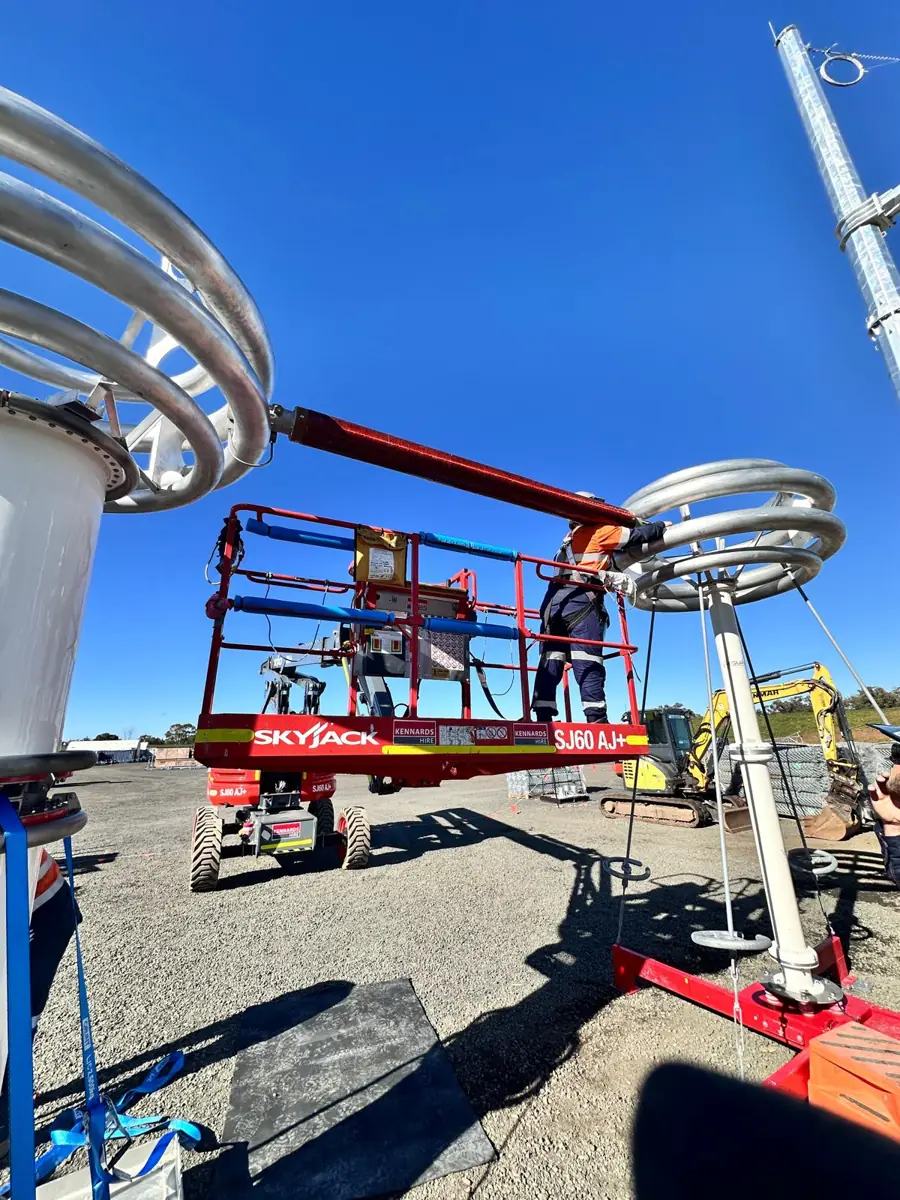
- Mobilise and erect. The 500 kV set travels in its 20-foot container and the 300 kV set on Megavar’s 11-tonne truck. The reactors, exciter and divider are lifted into position by crane or telehandler and erected to suit the yard layout and access.
- Insulation resistance before. Measured on each phase to the others and earth, to pre-qualify the insulation.
- Withstand. One phase at a time with the others earthed, the voltage is raised in the steps and timed holds set by the specification, with partial discharge measured where specified. Exclusion zones cover everything the test energises, including remote cable ends, under the asset owner’s permit.
- Insulation resistance after. Repeated on each phase and compared with the readings before the withstand.
- Report. Voltage, frequency, current and duration for every phase, with the partial discharge and insulation resistance results, the achieved partial discharge sensitivity and any defects found.
Partial discharge measurement during the withstand
A withstand test answers pass or fail. Measuring partial discharge (PD) during the withstand also shows whether a joint, termination or GIS compartment is discharging at voltages below breakdown, which a pass on its own cannot show. Megavar measures PD with an Omicron MPD system to IEC 60270 during the withstand and reports the achieved measurement sensitivity with every result. Series resonance lends itself to PD measurement because it produces a clean sine wave from a low-power supply. On transmission-class campaigns, Megavar works with a specialist PD partner.
What Megavar needs on site
| Item | Requirement |
|---|---|
| Test supply | 400/415 V three phase at each test position, from mains or a generator: 100 kVA for the 300 kV set; a 150 kVA generator minimum, 200 kVA preferred, for the 500 kV set |
| Lifting | Crane or telehandler with an operator to unload, erect, reposition and reload the set |
| Apparatus ready to test | Mechanically complete, clean, dry and isolated, with primary connections removed where the test requires |
| Load data | Cable length and size, or section capacitance, so the configuration is confirmed before mobilisation |
| Access and permits | An access permit covering everything the test energises, including remote cable ends |
| Weather | Outdoor testing proceeds in fair weather only |
Who uses resonant hipot testing?
- Transmission network service providers commissioning new cable circuits, GIS bays and transformers, or returning plant to service after a fault or repair.
- Distribution networks testing 66 kV and 132 kV cable circuits and GIS after installation.
- Principal contractors and cable installers who need the after-installation test completed and recorded for handover.
- Renewable generators and battery storage developers testing HV connection cables and substation GIS before energisation.
- Asset owners checking a transformer or cable after a lightning strike, a through-fault, transport or relocation.
Megavar’s resonant hipot clients include Downer, RJE Global, Siemens Energy and Beon Energy Solutions, including work on Transgrid projects through principal contractors.
Recent resonant hipot projects
- Bulubul BESS, Wuuluman NSW, for RJE Global (2026). HV withstand testing of the 330 kV hybrid GIS on the 500 kV resonant set, with withstand stages at 275 kV and 350 kV and partial discharge measured at 190 kV.
- Gnarwarre BESS terminal station, Victoria, for Beon Energy Solutions (2026). Withstand and partial discharge testing of CVTs, CTs, disconnectors, a station services VT and 245 kV dead tank circuit breakers, using the 500 kV set from two set-up positions at each switchyard.
- Derrimut Substation, Victoria, for Siemens Energy (2026). Megavar’s 500 kV set and operators supplied into the client’s test programme, with a retest on the 300 kV set.
- 25 MVA power transformer after a lightning strike. The transformer had been producing gas since the strike. Megavar tested its insulation with the 300 kV resonant set; it passed and stayed in service. Read the full account: Why HiPot a 25 MVA Power Transformer?
Where Megavar delivers resonant hipot testing
Megavar delivers resonant hipot testing from offices in Hobart, Launceston, Adelaide, Newcastle and Gladstone, across Tasmania, South Australia, Victoria, New South Wales and Queensland. The 500 kV set travels in a 20-foot shipping container and the 300 kV set on Megavar’s own truck, so both reach regional and remote sites without oversize transport. Megavar is certified to ISO 9001, ISO 14001 and ISO 45001 and holds electrical contractor licences in every Australian state.
Related services and guides
- HV Cable Testing (VLF withstand, sheath integrity and fault location for cables up to 36 kV and beyond)
- Partial Discharge Testing
- Transformer Testing Services
- High Voltage (HV) Testing
- Hipot Testing Guide: a field guide to HV withstand testing
- VLF Cable Testing Guide
Request a resonant hipot test
Send Megavar the cable length and size, or the section capacitance, with the test specification, and we will confirm the configuration and quote. Call 1300 730 499 or email service@megavar.com.au.
Frequently Asked Questions
Resonant Hipot Testing Services Australia
What is the difference between a hipot test and a resonant hipot test?
A hipot test is any withstand test that applies a voltage well above operating voltage to insulation for a set time. A resonant hipot test is an AC hipot test in which the voltage comes from a resonant circuit tuned to the item’s capacitance, so the supply only provides the losses. Megavar uses resonant sets for high-capacitance items such as HV cables, GIS and power transformers, where a conventional AC test transformer would need a supply as large as the test itself.
Why use a resonant test set instead of VLF for HV cables?
VLF testing at 0.1 Hz suits medium voltage cables; Megavar’s VLF sets test cables rated up to 36 kV. For HV and EHV extruded cables, IEC 60840:2020 (clause 16.3) and IEC 62067 set the after-installation test as an AC voltage at 20 to 300 Hz, which a resonant set delivers at close to power frequency. Megavar’s 300 kV and 500 kV resonant sets cover cables above 36 kV.
What voltage can Megavar test to?
Megavar tests to 500 kV AC, single phase, with its Phenix 500 kV resonant set, and to 300 kV with its SUTE 300 kV set. The 300 kV set carries more current in parallel, so it handles longer cables; the 500 kV set suits GIS, power transformers, reactors and short lengths of EHV cable.
How long a cable can Megavar's resonant set test?
It depends on the cable’s capacitance and the test voltage. As a guide, the 300 kV set tests about 3.1 km of 240 mm² 110 kV XLPE cable at 132 kV with its reactors in parallel, or about 1.3 km of 400 mm² 220 kV cable at 216 kV in series. Send Megavar the cable length and size, and the configuration is confirmed before we quote.
Can partial discharge be measured during a resonant hipot test?
Yes. Megavar measures partial discharge with an Omicron MPD system to IEC 60270 during the withstand, working with a specialist PD partner on transmission-class campaigns, and reports the achieved sensitivity with every result. PD measurement shows discharging joints, terminations or GIS compartments that a pass or fail result alone cannot show.
Does a resonant withstand test damage healthy insulation?
A withstand test at the level set by the equipment standard and the asset owner’s specification is designed to be passed by sound insulation. If the insulation does break down, the resonant circuit detunes and the voltage collapses, so the follow-through current is low and there is generally less damage than with a conventional source.
Can I hire Megavar's resonant test sets without an operator?
No. Megavar’s 300 kV and 500 kV resonant sets are supplied only with Megavar’s own test team, either as a full test service or as operated hire into your test programme. They are not available for dry hire.
What does Megavar need on site for a resonant hipot test?
A 400/415 V three phase supply of 100 kVA for the 300 kV set, or 150 to 200 kVA for the 500 kV set; a crane or telehandler with an operator; apparatus that is mechanically complete, clean, dry and isolated; the cable length and size or section capacitance; and an access permit covering everything the test energises. Outdoor testing proceeds in fair weather only.
How much does resonant hipot testing cost?
Megavar quotes each resonant test per project. The price depends on the distance to site, the number of phases and test sections, the voltage profile and hold times, whether partial discharge measurement is included, and whether the client provides the supply and the crane. Call 1300 730 499 or email service@megavar.com.au with the test specification for a quote.
What is the difference between an applied voltage test and an induced voltage test on a transformer?
The applied voltage test energises one winding from an external source with the other windings and the tank earthed, and proves the insulation from that winding to earth. The induced voltage (induced overpotential) test excites the transformer from its own winding above rated voltage at a raised frequency, and stresses the turn-to-turn and phase-to-phase insulation. Megavar runs applied voltage tests with its resonant sets and offers induced testing by the single-phase per limb method case by case; its resonant sets are single phase, so where a three-phase induced test is specified Megavar says so at enquiry.
ISO Certified and Licensed in Every State
Megavar is certified to ISO 9001 (quality), ISO 14001 (environment) and ISO 45001 (safety), and holds electrical contractors licences in every Australian state.
Ready to book a resonant hipot test? Contact Megavar today on 1300 730 499 or visit our contact page to request a quote.
Explore Our other services
Protection relay testing and secondary injection across Australia. Schemes proven to specification by Megavar's commissioning engineers. Enquire today.

HV earthing design and testing. Earth grid design, soil resistivity, injection testing and step and touch surveys for substations across Australia.
HV reticulation and distribution design across Australia: overhead and underground networks, URD, powerline design and DNSP-ready drafting, 415V to 132kV.

Capability statement
High-Voltage Resonant Hipot Testing
AC withstand testing to 500 kV on Megavar-owned resonant test sets, with partial discharge measurement.
Trusted by top enterprises for exceptional results


Explore the latest insights